


I’m working on my book about the history of probability and statistics and sharing a few interesting snippets from it. For frequent updates, follow me on X.
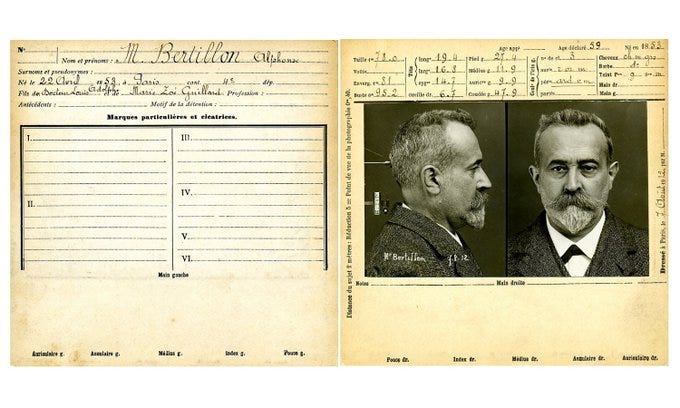
Alphonse Bertillon’s “first mug shot” in 1888 wasn’t just a photograph. It marked the beginning of biometric statistics and introduced a systematic way to measure and classify the human body. By combining photography with precise physical measurements, Bertillon created a method for identifying individuals that influenced policing, criminology and early data-driven approaches to human variation. His work showed how images and numbers could be linked, opening a path toward modern biometric systems and the broader use of quantitative methods in studying people.
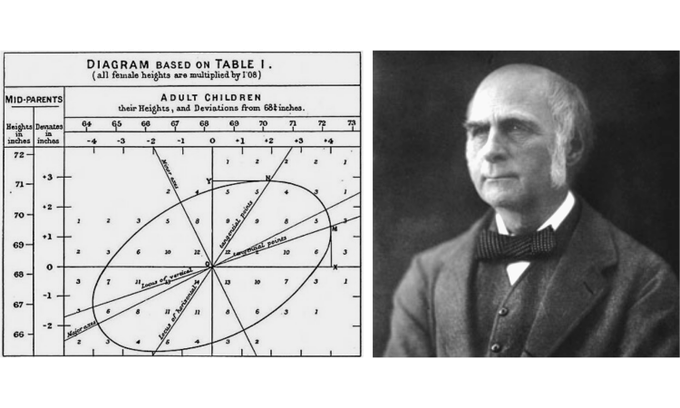
Francis Galton turned heredity into measurable science and helped transform questions about human traits into problems that could be studied with data. His famous height diagram illustrated how parents and children resemble one another while also drifting toward average values, a pattern that led him to the idea of regression to the mean. In exploring these patterns, Galton also introduced early notions of correlation, showing how two variables can move together in predictable ways. Through his efforts to quantify inheritance, he laid important groundwork for modern statistics and for the study of variation within populations.
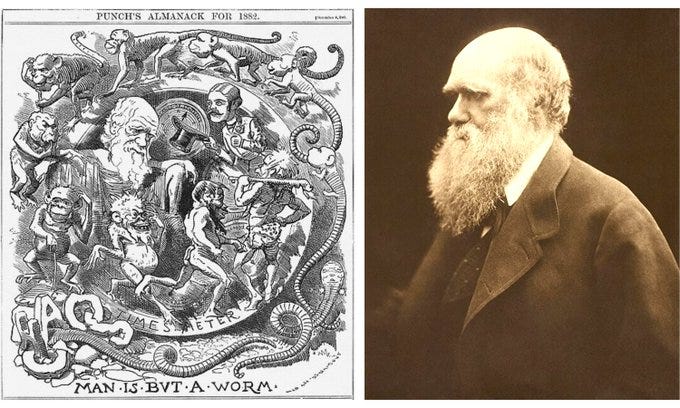
Charles Darwin, Francis Galton’s cousin, was reshaping biology with his theory of evolution and offering a new way to understand how species change over deep stretches of time. His ideas influenced scientists across many fields, including Galton, who drew on Darwin’s emphasis on variation and inheritance when developing his own statistical studies of human traits. Darwin’s work also sparked public fascination and satire, captured vividly in the Man is But a Worm illustration from Punch’s Almanack in 1881, which exaggerated evolutionary themes to comment on how his ideas were being received. Even in caricature, the image reflects how profoundly Darwin transformed scientific thinking and opened new paths for studying heredity and variation.
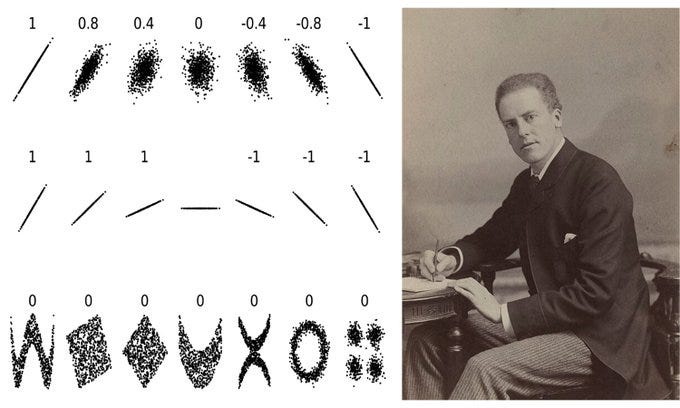
Karl Pearson applied statistical thinking directly to biological questions, studying evolution, heredity and natural variation in populations, and he used quantitative methods to analyze topics such as insect coloration, human physical traits and the spread of diseases. His work introduced a more rigorous, mathematical understanding of variation and relationships within data, giving scientists tools that remain central today. One of his most influential contributions is the Pearson correlation coefficient, a single number that summarizes how two variables move in relation to each other. It reflects both the direction of their relationship and the strength of the association, allowing researchers to quickly gauge whether two patterns rise together, fall together or show little connection at all. Pearson also developed a broad family of probability distributions to model the many shapes that real biological data can take, providing researchers with flexible tools for describing skewed, asymmetric or otherwise complex patterns in nature.
More updates soon as the manuscript continues to take shape. All images are in the public domain via Wikimedia Commons.